The Horse Nobody Wanted
Kingston Town was bred by Melbourne financier David Hains, but when the near-black colt was offered at the yearling sales, he failed to reach even a modest reserve. Nobody wanted him. Hains decided to race the horse himself and sent him to Tommy Smith at Tulloch Lodge — the same stables named after the champion Tulloch.
His debut at Canterbury in March 1979 was a disaster. He ran last. The stable foreman called it “a disgraceful performance” and said he “just wouldn’t try.” Smith’s solution was blunt: geld him. Owner Hains agreed, ending any breeding career before it started.
The transformation was immediate. Kingston Town returned as a gelding and reeled off six consecutive wins. By the end of his four-year-old season, he’d won 14 of 18 starts, including the Queensland Derby at Eagle Farm, and was named Australian Champion Racehorse. He was the first horse in Australia to pass $1 million in prize money.
Bill Collins
Three Cox Plates
The W.S. Cox Plate at Moonee Valley is Australia’s weight-for-age championship — 2040 metres on a tight, turning track that demands tactical brilliance and raw courage. Kingston Town won it three consecutive years: 1980, 1981, and 1982. No horse had done it before. Only Winx, with four straight from 2015 to 2018, has surpassed it since.
The 1982 victory became one of the most replayed moments in Australian racing history. Approaching the home turn, Kingston Town appeared beaten — struggling to make ground as the field sprinted away. Commentator Bill Collins declared to his national audience: “Kingston Town can’t win.”
What happened next wrote itself into legend. Finding a reserve of stamina that defied the visual evidence, Kingston Town surged past the leaders in the final metres. Collins scrambled to correct himself: “He might win yet the champ… Kingston Town’s swamping them!” He won by a neck from Grosvenor. The incorrect call became inseparable from the victory — you can’t tell the story of one without the other.
Timeform
Enter the New Zealanders
Four years after Kingston Town’s third Cox Plate, the 1986 edition brought a different kind of drama. Two New Zealand champions arrived at Moonee Valley carrying the weight of an entire nation’s expectations: Bonecrusher and Our Waverley Star.
Bonecrusher — nicknamed “Big Red” — was purchased for just NZ$3,250 at the Waikato Yearling Sales. Trained by Frank Ritchie and ridden by Gary Stewart, he’d already won the New Zealand Derby, the Australian Derby, and the Tancred Stakes. He was installed as 6/4 on favourite.
Our Waverley Star, ridden by Lance O’Sullivan, had won 10 of 13 starts in New Zealand. He’d actually beaten Bonecrusher in their most recent encounter — the Admiralty Handicap at Ellerslie. The trans-Tasman rivalry had captured the public imagination on both sides of the ditch.
The Race of the Century
What transpired over the final 800 metres at Moonee Valley on 25 October 1986 remains the most famous horse race in Australian and New Zealand history.
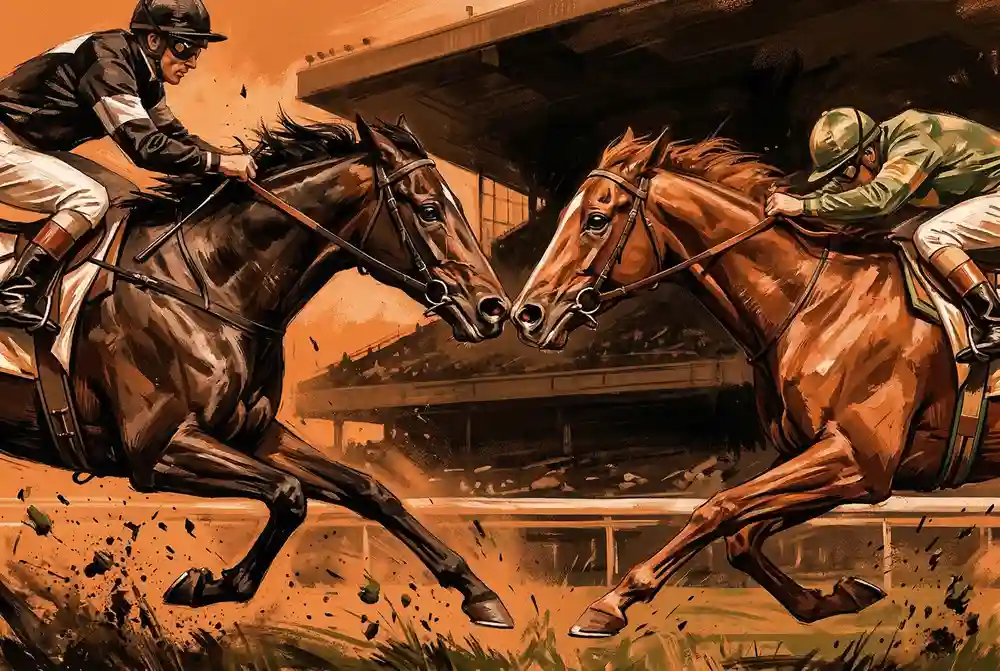
At the 800-metre mark, Gary Stewart sent Bonecrusher wide around the field. Lance O’Sullivan on Our Waverley Star immediately followed. The two horses broke completely clear of the rest of the elite field and began a sustained, brutal duel that lasted the entire final half of the race.
Stride for stride around Moonee Valley’s tight turns. Our Waverley Star built a half-length lead. Bonecrusher fought back. The crowd was roaring. Bill Collins questioned whether they’d gone too early. The third placegetter, The Filbert, was left lengths behind — three New Zealand horses filled the placings, but only two were racing.
In the final desperate strides, Bonecrusher dug deepest, edging past Our Waverley Star to win by a neck. Collins’ call: “Bonecrusher races into equine immortality!” The physical toll was so immense that Bonecrusher required immediate veterinary treatment for severe exhaustion.
Racing History
Why the Cox Plate Creates Legends
Moonee Valley is unlike any other major racecourse in Australia. It’s tight, it’s turning, and the home straight is desperately short — just 173 metres. There’s nowhere to hide and no room for error. A horse that’s boxed in on the rail at the 400-metre mark might never find clear running.
This is why the Cox Plate rewards a very specific type of horse: one with tactical speed, raw stamina, and fierce courage. Kingston Town possessed all three despite his quirks on left-handed tracks. Bonecrusher’s willingness to sustain an 800-metre sprint against an equally brave rival demonstrated the quality that separates champions from good horses — the refusal to surrender.
The Cox Plate roll of honour reads like a who’s who of Australian racing: Phar Lap, Tulloch, Kingston Town, Bonecrusher, Super Impose, Winx. Every one of them proved their worth on Moonee Valley’s demanding circuit.
What This Teaches Us
These two Cox Plate stories teach different lessons. Kingston Town shows that a horse’s potential isn’t always obvious at first glance — he ran last on debut, failed to sell at auction, and struggled on Melbourne tracks. Yet he became one of the highest-rated racehorses in Australian history. The form guide captures a moment in time, not the full story.
The Race of the Century demonstrates why weight-for-age racing produces the sport’s greatest spectacles. With no handicap pen to separate them, two champions met on equal terms and settled the argument on the track. That’s the Cox Plate’s fundamental promise.
For newcomers, these stories explain why racing fans speak about the Cox Plate with a reverence usually reserved for the Melbourne Cup. The Cup is the people’s race. The Cox Plate is the champion’s race.
Tulloch Lodge
Up Next
Next Lesson