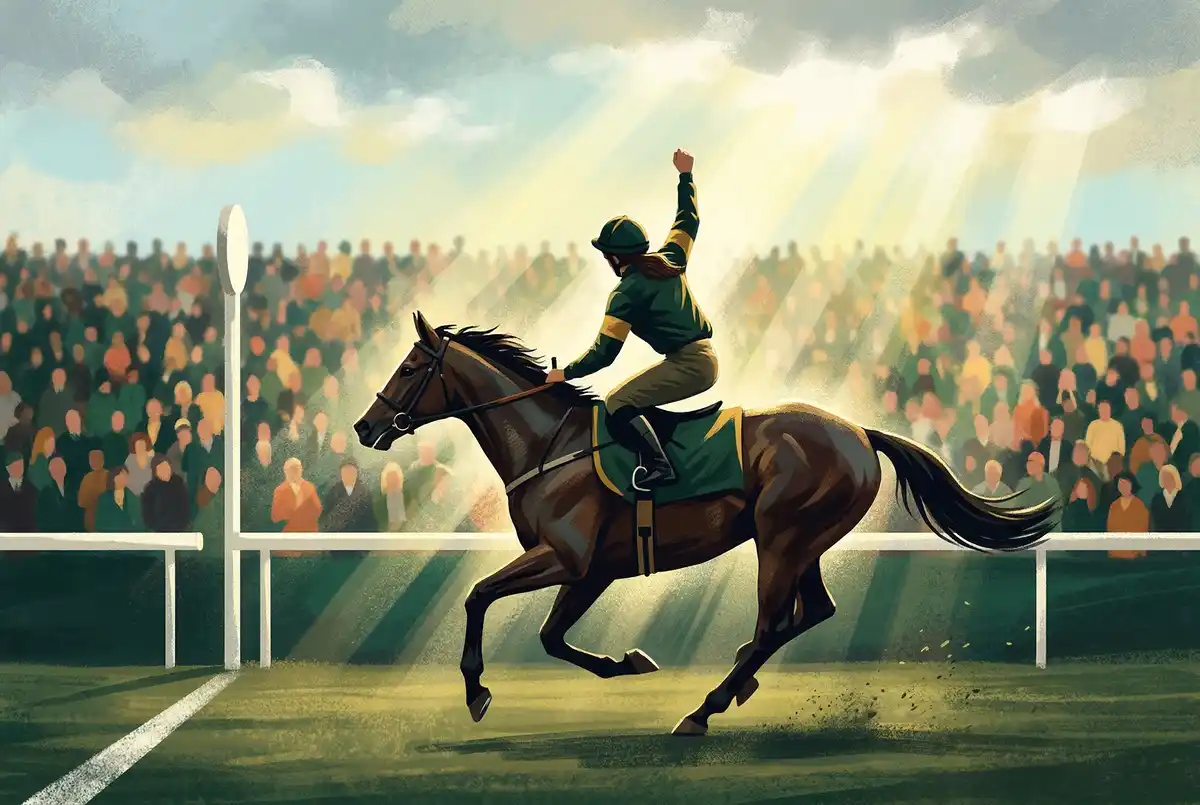
She was the youngest of ten kids, raised by a single father on a farm near Ballarat. She fractured her skull in a race fall, lost a sister to the same sport, and was told repeatedly that women were not strong enough. On the first Tuesday in November 2015, aboard a 100-to-1 outsider, she proved every one of them wrong.
Miners Rest
The Payne dynasty
The Paynes are not just a racing family. They are a racing dynasty. Paddy Payne, a New Zealander from Hawera in South Taranaki, moved his family to Miners Rest near Ballarat and built a life around horses. When his wife Mary was killed in a car accident, Michelle was just six months old. Paddy was left to raise ten children alone.
Eight of the ten became jockeys. Patrick won a Cox Plate. Two of Michelle’s brothers-in-law, Brett Prebble and Kerrin McEvoy, are Melbourne Cup winners. The only sibling who did not work with horses was Margaret, who became an accountant.
And then there was Stevie. Stephen Payne, the second youngest, was born with Down syndrome. He could not be a jockey, but he could work with horses. He became a strapper, the person who cares for racehorses before and after a race: grooming them, saddling them, and leading them to the mounting yard. Stevie and Michelle, the two youngest, were inseparable.
Family
Ten children
The Paynes grew up around horses after Paddy Payne raised the family near Ballarat.
Behind Scenes
Stevie
Stephen Payne strapped Prince of Penzance and became part of the Cup-day story.
Partnership
A patient ride
Michelle knew the horse well enough to wait, save ground, and push through when the gap arrived.
Racing Roles
Falls and Return
Broken but not beaten
At age seven, Michelle told her friends she would win the Melbourne Cup. At fifteen, she had her first ride. At eighteen, her career nearly ended.
In March 2004, her mount Vladivostok collapsed 100 metres past the finishing post at Sandown. Michelle was thrown headfirst into the turf. The result: a fractured skull and bleeding on the brain. It took four years to fully recover.
Then in 2007, the unthinkable. Eldest sister Brigid, also a jockey, suffered a fall during trackwork. She was placed in an induced coma. Six months later, she died from a heart attack caused by a seizure from her injuries. She was 36.
“It made me think, live your life and don’t hold back, because you only get one chance at it.”
In 2012, two more falls fractured nine of her vertebrae. Her family begged her to stop. She kept riding.
The Horse
Prince of Penzance was no superstar
Prince of Penzance was no superstar. The New Zealand-bred gelding had been bought for $50,000, pocket change in thoroughbred racing, by six self-described “small-fry owners”: a podiatrist, two engineers, an IT consultant, a solutions expert, and a producer. They had paid $5,000 each.
The horse had battled sickness and injury throughout his career, but Michelle believed in him from the moment she first rode him as a three-year-old. “He won here and I thought, this is a Melbourne Cup horse,” she said. She became his regular jockey, and together they built the kind of partnership that is hard to put on paper.
Trainer Darren Weir backed Michelle when others did not. Some of the owners wanted her replaced with a more established male jockey. Owner John Richards and Weir held firm. Michelle stayed on.
Jockey-Horse Partnership
Cup Day
The first Tuesday in November
Melbourne Cup Day, 3 November 2015. Prince of Penzance was a 100-to-1 outsider in a field of 24. The Japanese stayer Fame Game was favourite. British raider Trip to Paris was fancied. Max Dynamite, ridden by the great Frankie Dettori, was in the mix.
Michelle was only the fourth woman to ride in the Cup in its 155-year history. She drew barrier one, pulled from the hat by Stevie.
In the mounting yard, she looked down at her brother and smiled. “Who would have thought all those years ago watching Phar Lap that we’d be here about to race in the biggest race together?” she recalled thinking. As the barriers opened, she said a silent prayer to her mother and to Brigid.
Prince of Penzance settled mid-field. As the field straightened for the final run, Michelle pushed through a narrow gap. The horse surged. With 200 metres to go, exactly as Stevie had predicted, they hit the front. Prince of Penzance held off Max Dynamite by half a length.
The first female jockey to win the Melbourne Cup. A 100-to-1 outsider. The biggest upset since Old Rowley in 1940.
Racecard Extract
2015 Melbourne Cup
Flemington / 3200m
- HorsePrince of Penzance
- JockeyMichelle Payne
- Barrier1drawn by Stevie
- Starting price100-1
- Winning marginHalf length
The draw, the light weight, the patient ride, and the horse-jockey partnership all mattered.
The Interview
The line heard around the world
What happened next became as famous as the win itself.
In her post-race interview, still breathless, Michelle said: “It’s such a chauvinistic sport. A lot of the owners wanted to kick me off. Everyone else can get stuffed who think women aren’t good enough.”
It was unscripted, unfiltered, and unforgettable. Australia cheered.
She was coincidentally wearing colours that matched the suffragette movement: purple, green, and white. Governor-General Sir Peter Cosgrove and other dignitaries were criticised for delivering pre-prepared speeches that failed to acknowledge the historic nature of what had just happened.
Stevie led Michelle and Prince of Penzance back to the scales. He told the crowd: “Thank you very much, everybody. I hope you all have a great night.” He had already collected his winnings: $10 at 100/1.
The story became a movie, Ride Like a Girl (2019), directed by Rachel Griffiths, with Teresa Palmer as Michelle, Sam Neill as Paddy, and Stevie playing himself. It grossed $11.5 million at the Australian box office.
What It Teaches
The ride changed what beginners could see
Michelle Payne’s story is not just about one race. It is about what the Melbourne Cup means to Australians, and what racing can be when its barriers come down.
She showed that strength in the saddle is not just about arms and legs. “It’s not all about strength,” she said. “There is so much more involved: getting the horse to try for you. It’s being patient.”
She showed that ownership does not require millions. Six people paying $5,000 each watched their horse win Australia’s richest race.
And through Stevie, she showed that racing has room for everyone: that the people behind the scenes are just as important as those in the spotlight.
Legacy
Melbourne Cup
Up Next
Next Lesson