Brisbane racecourse guide
Eagle Farm
Racecourse
Queensland's premier racing venue, explained through its long straight, wide turns, Ascot arrival points, and first-visit landmarks.
2,027m circuit · 434m straight · Ascot
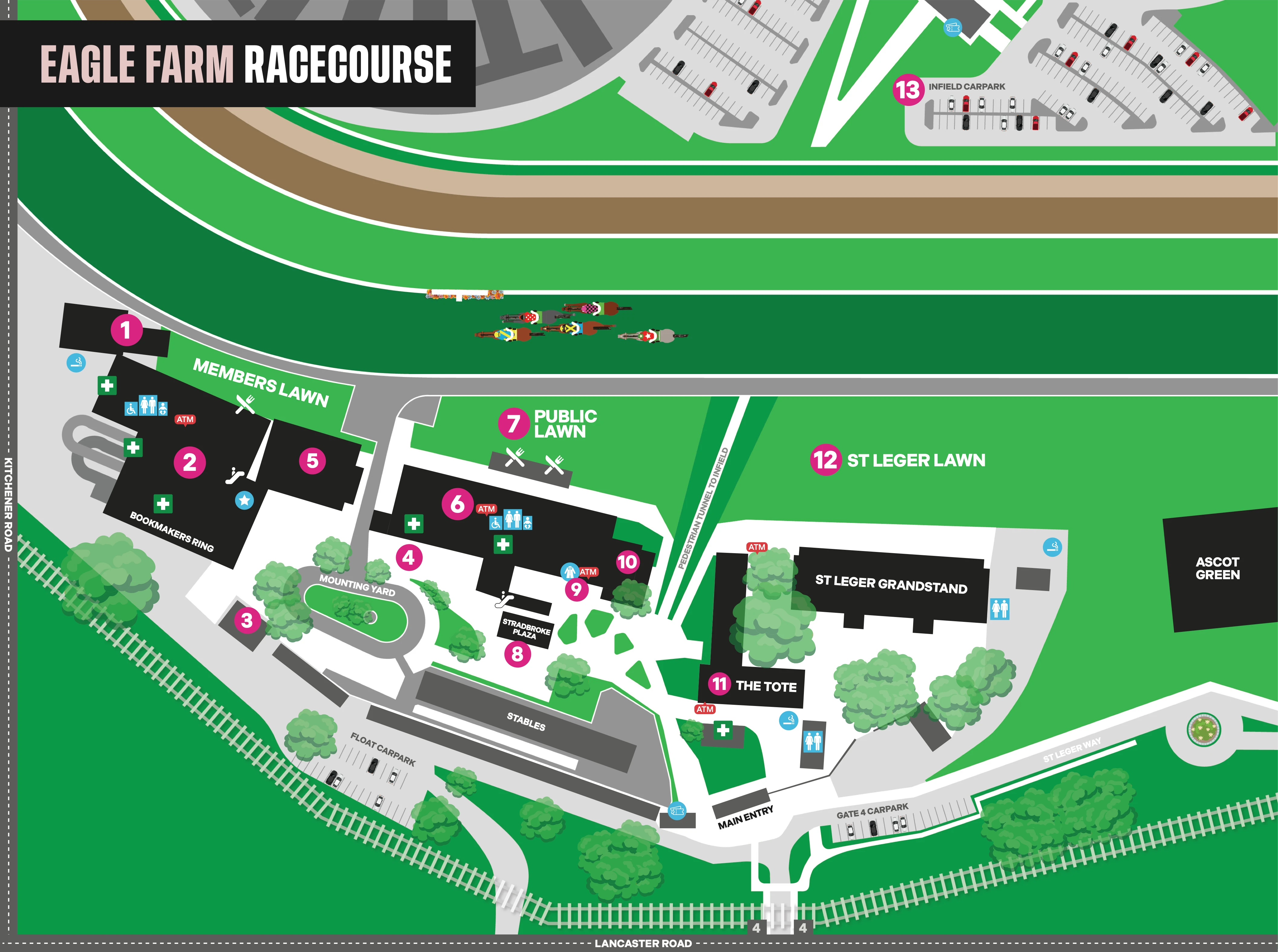
First Racecourse Read
Start with the shape of the place. Eagle Farm is spacious, green, and less frantic than a concrete stadium: the track is broad, the straight feels long from the lawn, and the visitor flow is built around Ascot Station, Gate 4, the public grandstand, and Stradbroke Plaza.
Quick Orientation
The racecourse sits beside Doomben, but the racing feel is much wider and more stamina-based.
The old bridge is closed, so first-timers should exit the station and walk via Racecourse Road and Lancaster Road.
Big June crowds gather around the public lawn, mounting yard, and grandstand terraces.
How the Course Reads
Wide circuit
Horses get room to balance instead of being forced through tight corners.
Long straight
Leaders can look safe at the 200m mark and still be caught late.
Visitor rhythm
Map first, then pick a base: Public Grandstand, Public Lawn, Stradbroke Plaza, or St Leger Lawn.
What Makes Eagle Farm Special?
Unlike tighter tracks where tactical positioning dominates, Eagle Farm is a "galloper's track." The sweeping turns and expansive dimensions reward horses with genuine class and staying power. There's nowhere to hide here — if you don't have the engine, the long uphill finish will find you out.
The track sits less than 1km from Doomben Racecourse, creating Queensland's unique "racing precinct." But don't be fooled by their proximity — they're completely different racing experiences. Doomben is tight and tactical; Eagle Farm is wide and stamina-testing.
Understanding the Track
Shape
The simplified diagram shows why Eagle Farm is described as a galloping track: broad corners, a long run home, and starting chutes that give different race distances very different rhythms.
Learning cue
When reading form for an Eagle Farm race, ask whether the horse wants room, time to build momentum, and enough stamina for the final rise.
Why Size Matters
At 2,027 metres around, Eagle Farm gives horses room to breathe. The turns are sweeping rather than sharp, meaning horses can maintain momentum without breaking stride. But here's the kicker: that famous 434-metre home straight isn't flat.
The Hidden Challenge
While it looks flat to spectators, the track actually rises about 4 metres from the 800m mark to the winning post. This gentle uphill drag tests every horse's cardiovascular fitness. You'll often see leaders kicking clear at the 200m mark, only to be run down in the final 100m by horses with better stamina reserves.
Eagle Farm Elevation Profile
Elevation changes shown for educational purposes. Actual gradients may vary.
Track Conditions You'll Hear About
BRC Staff Insight
The Eagle Farm Story
You might hear older racing enthusiasts mention "the dark days" of Eagle Farm. Here's what happened:
In 2014, the track closed for a major renovation meant to create a world-class racing surface. When it reopened, disaster struck — the new surface was unstable, horses lost their footing, and the industry demanded answers.
What went wrong?
- Wrong grass: Budget cuts meant using "sprigs" instead of established turf, so roots weren't strong enough
- Wrong sand: The sand profile didn't "lock" together under the 500kg impact of galloping horses
- The surface literally shifted beneath them
After an independent inquiry (the "Monteith Report"), the entire surface was stripped and rebuilt properly — new sand profile, new Grand Prix couch grass surface, proper drainage. Since returning to full operation, the track has regained industry confidence and now handles even heavy rain loads beautifully.
BRC Staff Insight
Starting Positions & Race Patterns
Understanding how starting positions affect racing helps explain why races at Eagle Farm often play out differently than at other tracks.
Sprint Races (1000m–1200m): Wide Barriers Often Fare Better
Eagle Farm - Sprint Races
Barrier draw win rate analysis
Barrier Number
Pattern: Outside barriers (4-8) perform best - avoiding rail congestion on sweeping turns.
Barriers 4-8 perform best (10-12% win rate)
Historical win rates shown for educational purposes. Past performance does not predict future outcomes.
Why this happens: Horses drawn inside (Barriers 1–3) face enormous pressure to jump cleanly and hold position. If they don't, they get buried on the rail with nowhere to go. The sweeping home turn means the field fans out, and horses stuck on the fence often find themselves blocked behind tiring leaders.
The pattern: Barriers 4–8 perform better statistically because they let jockeys settle "one off the fence," keeping options open to angle wide in the straight.
Middle Distance (1400m–1600m): The Fairest Start in Racing
The Stradbroke Handicap (1400m) starts in a chute at the back of the course, providing over 400 metres of straight running before the first turn.
Why this matters: Wide barriers aren't the disadvantage they are at other tracks. Horses drawn in Barrier 14 have ample time to drift across and find position without burning energy. Stradbroke winners have come from barrier 3 (Santa Ana Lane, 2018) and barrier 12 (Tofane, 2021) — class can overcome the draw here.
Staying Races (1800m+): Inside Positions Dominate
Eagle Farm - Staying Races
Barrier draw win rate analysis
Barrier Number
Pattern: Inside barriers (1-4) perform best - rail position saves ground over longer distances.
Barrier 1 has massive 25.8% advantage over distance
Historical win rates shown for educational purposes. Past performance does not predict future outcomes.
Why this happens: Over 2km, energy conservation is everything. A horse on the rail travels significantly less distance than one stuck three-wide. The gentle turns mean the rail horse never wastes energy scrubbing around tight corners, leaving more fuel for that punishing uphill finish.
BRC Staff Insight
Educational Note: Statistical patterns compiled from publicly available racing data for educational purposes to help understand race dynamics. Past performance is not indicative of future results.
Eagle Farm vs Doomben
These tracks are neighbours but polar opposites. Understanding the difference helps explain why horses perform differently at each venue.
Doomben
- Tight, rectangular track (1,715m)
- Short straights
- Favours agile, sharp-turning horses
- Leaders often hold on as backmarkers struggle to wind up
Eagle Farm
- Expansive, galloping track (2027m)
- Long straight (434m)
- Favours big-striding, stamina-rich horses
- Backmarkers have time to run down leaders
The "Form Reversal" Pattern
It's common for a horse to run poorly at Doomben (trapped, couldn't turn) then perform impressively at Eagle Farm two weeks later. Experienced racing fans understand that Doomben form doesn't always translate — horses suited to Eagle Farm's wide spaces often need that extra room to show their best.
This explains why trainers often target specific horses at Eagle Farm after disappointing Doomben runs — they're simply better suited to the galloping demands of the bigger track.
Planning Your Visit
Getting There
By Train
Ascot Railway Station is right next to the track.
Good to know: the heritage railway footbridge to the track is closed to pedestrians, so exit the station and walk around to Gate 4 at the corner of Racecourse Road and Lancaster Road — about a 5–10 minute walk. It catches a lot of first-timers out, so allow a few extra minutes.
By Car
Free parking in the Infield Carpark — accessed via Nudgee Road (near Racecourse Village Shopping Centre) through the tunnel under the track. Fills fast on Carnival days — arrive early.
By Rideshare
Drop-off on Lancaster Road — exit via Gate 4 and walk towards Charlton Street. Taxis available from McGill Avenue.
First Furlong Note
Best Viewing Spots
The Public Lawn (200m mark)
Stand at the fence and experience the visceral thrill of 15 horses thundering past at 60km/h. You'll hear jockeys shouting and hooves pounding turf. Gets crowded — claim your spot early.
The Mounting Yard
Perfect for assessing horses before races. Watch for horses sweating profusely ("washing out") — they're stressed and often struggle on the big track.
The Old St Leger Stand
A quieter heritage building with elevated views. Favoured by serious racing fans who want to concentrate without the carnival atmosphere.
The Society Rooftop (Public)
Instagram-ready rooftop bar with Aperol Spritz, DJs, and panoramic views. More about the social scene than serious race-watching.
Food & Drink
Rough Habit Lounge (Members, Level 2)
Premium race-day experience with elevated 180-degree trackside viewing. Access is via escalators near Stradbroke Plaza (no lift access). Dress code is smart casual.
Guineas Room (Members, Level 2)
Premium a la carte dining with seasonal Queensland produce. Book weeks ahead for Carnival days.
Stradbroke Plaza (Ground Level)
Gourmet food trucks under fig trees — burgers, pizzas, coffee. More casual and relaxed.
Members vs Public — Is It Worth It?
General Admission ($20–$40)
- * Excellent lawn access
- * Close to the public lawn and main facilities
- * Can get crowded on big days
- * More limited facilities
Members Reserve (Day Pass ~$75)
- * Prime viewing around the winning post
- * Air-conditioned comfort
- * Less crowded bars and bathrooms
- * Reserved seating available
Honest verdict: For a first-timer on a pleasant winter day, General Admission is excellent value. But on a sweltering December day or Stradbroke's tens-of-thousands-strong crush, the Members comfort is worth the extra cost.
Weather (This is Brisbane!)
Summer Racing (Nov–Mar)
Can be brutally hot and humid. Bring sunscreen, hat, and water. The track offers little shade. Air-conditioned areas become vital by 2pm.
Winter Carnival (May–Jun)
Mornings can be 12 degrees C, afternoons 25 degrees C. Layer your clothing. Brisbane winter is unpredictable — it might rain, it might be perfect, it might do both.
BRC Staff Insight
Interactive Venue Map
Dining and bars are also found inside grandstands — tap any building for full details.
Pinch to zoom · Double-tap to reset
The Winter Racing Carnival
Winter Carnival
May–June — Brisbane's Grand Final
The pinnacle of Queensland racing. Crowds reach into the tens of thousands and the atmosphere is electric — comparable to a preliminary final in the NRL.
Stradbroke Handicap
Feature Race$3M · 1400m
HandicapFamous for its brutal tempo; only horses with genuine class survive. Stradbroke Handicap Day (June) is the pinnacle — this is where the carnival reaches its crescendo.
Queensland Oaks
Fillies2200m · June
One of Queensland's premier races for fillies. The 2015 running was held at Doomben while Eagle Farm was being rebuilt — that year, a young mare named Winx won it during her historic 33-race winning streak.
Queensland Derby
3YO2400m · May/June
The classic stamina test for 3YO stayers. A true test of staying ability on Eagle Farm's wide-open track.
Tattersall's Tiara
Fillies & MaresLate June
The final Group 1 of the Australian season. Famous for "Fashions on the Field" — this is Brisbane's social event of the year.
Other Big Days
Melbourne Cup Day (November)
While the race runs in Melbourne, Eagle Farm hosts a massive event. This is the busiest day for corporate hospitality and casual racegoers who only attend once a year.
Regular Saturdays
Eagle Farm races roughly every second Saturday (alternating with Doomben). These are quieter, family-friendly days — ideal for first-timers who want to learn without the carnival chaos.
Course Notes
On a Tuesday at 4am, the track is alive with hundreds of horses working on training tracks in the dark — quiet, industrial, methodical. Then on Stradbroke Day, tens of thousands roar as horses flash past. That contrast between dawn training and carnival chaos is the essence of Eagle Farm.
What Surprises First-Timers
The sheer scale. Until you stand on the lawn and watch horses gallop past, you don't appreciate how big and fast thoroughbreds are. The track itself feels massive compared to photos — that 434m straight seems to go forever.
Venue Notes Staff Point Out
- The bathrooms near the mounting yard (Members) are always less crowded than the main grandstand ones
- The infield parking tunnel is a secret weapon — most people don't know it exists
- If you want to see horses up close, arrive for Race 1 and walk through the mounting yard when it's still quiet
- The fig trees on Stradbroke Plaza provide the best shade — claim that spot early on hot days
The "Green" Surprise
First-time visitors are often struck by how green and park-like Eagle Farm feels. Unlike concrete stadium-style tracks, the venue has fig trees, heritage timber buildings, and manicured lawns. It feels like a garden party that happens to have horse racing.
Heritage Status
The St Leger Stand, wrought-iron entrance gates, and old Totalisator building are heritage-listed. Walking through them connects you to 160 years of Queensland sporting history.
Eagle Farm rewards those who take the time to understand it. Unlike tracks where a lucky barrier draw or a quick start can steal the race, the Farm demands honesty — you need genuine class, fitness, and heart to win here.
Whether you're standing on the lawn for the Stradbroke roar, sipping champagne in the Guineas Room, or studying sectionals in the St Leger Stand, you're experiencing Queensland's premier racing theatre.
First-Timer Checklist
- Arrive via Gate 4 if coming by train
- Claim a lawn spot early on big days
- Visit the mounting yard to see horses up close
- Watch at least one race from the 200m fence
- Bring layers in winter (weather changes)
- Use Level 2 lounge areas for air-conditioned comfort on hot days
- Respect the uphill finish — stamina wins here
See you at the Farm!
First Furlong is an independent educational resource. References to racing clubs are for educational context only — we are not affiliated with, endorsed by, or partnered with any racing club.
Brisbane Racing Club(BRC)
Manages Eagle Farm and Doomben racecourses, home of the Brisbane Racing Carnival.
Up Next
Next Lesson
Doomben Track Profile
Keep Learning
Doomben Track Profile
BRC's other track — tighter turns, stronger inside bias, garden party atmosphere
Flemington Racecourse
Home of the Melbourne Cup — Australia's most famous racecourse and its dramatic straight-six layout
Stradbroke Day Survival Guide
Eagle Farm's biggest day — field notes for Queensland's premier race
Royal Randwick
Australia's racing headquarters — home of The Everest and around 20 Group 1 races per season