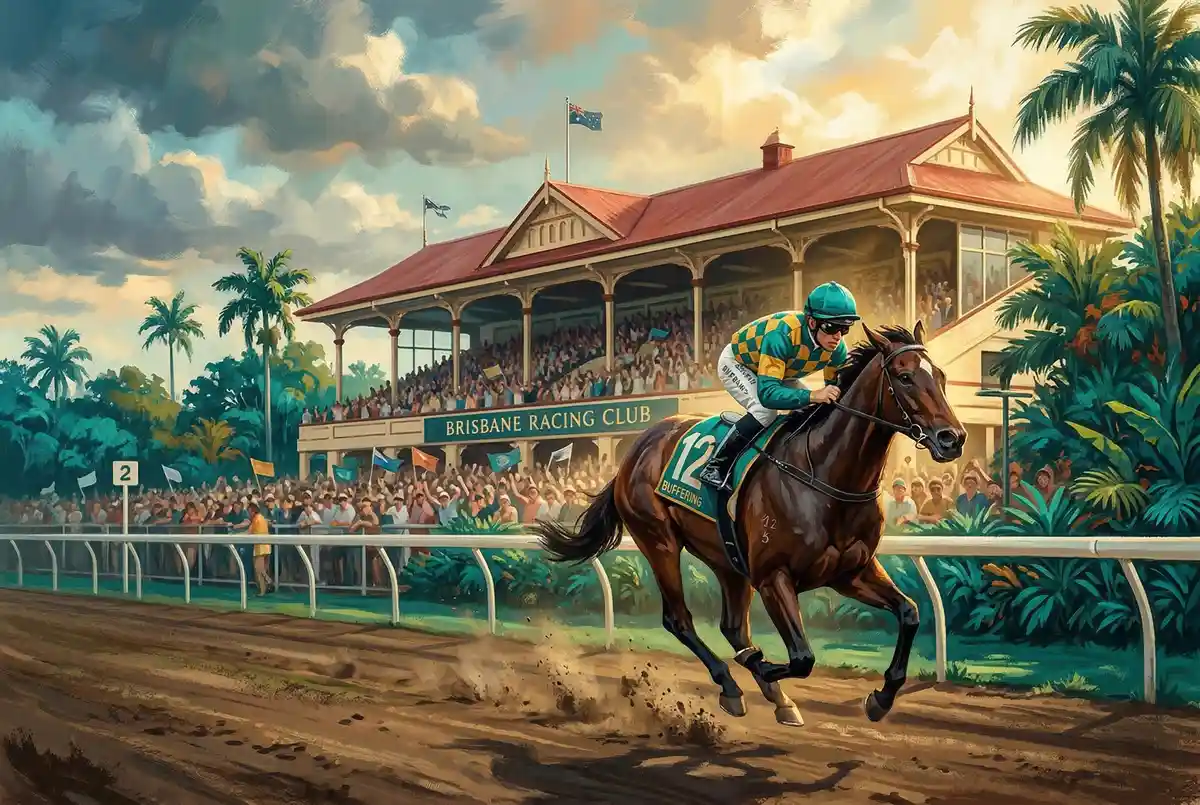
The Magic Millions Bargain
In 2009, Brisbane trainer Robert Heathcote walked through the Magic Millions sales ring and spotted a Mossman colt with potential. The hammer fell at $22,000 — a modest sum, even by yearling sale standards. No one knew that this bargain buy would rewrite Queensland racing history.
Named Buffering, the bay colt wasn’t flashy. He didn’t come from a champion bloodline. He didn’t break auction records. But Heathcote saw something that others missed — a fighter’s spirit wrapped in an unassuming package.
That $22,000 investment would eventually return over $7.2 million in prize money, making Buffering the highest-earning Queensland racehorse of all time. Not bad for a horse that cost less than a second-hand car.
Yearling Sales
The Long Road to Group 1 Glory
Buffering wasn’t an overnight sensation. Along the way, he was beaten by champions like Black Caviar, Hay List, and Foxwedge. He placed in ten of his first 17 Group 1 attempts — always close, never quite there.
Then, in October 2013, everything clicked. At age six, Buffering stormed home to win the Manikato Stakes at Moonee Valley — his first Group 1, on his 36th career start and 18th attempt at the top level. And he didn’t stop there.
Over the next 13 starts, he won six more Group 1 races — the VRC Sprint Classic, Winterbottom Stakes (twice), Moir Stakes, and the international Al Quoz Sprint in Dubai. The horse that couldn’t win a Group 1 became a Group 1 specialist.
Patience Pays
Racing Alongside Black Caviar
Buffering’s career overlapped with Black Caviar, the undefeated champion who won 25 from 25. Buffering never beat her — no one did. But he earned respect for showing up, racing hard, and refusing to be intimidated by greatness.
When Black Caviar won the 2011 BTC Cup at Doomben, Buffering was there. When she dominated sprint races across the country, Buffering lined up against her and gave everything he had. He lost no admirers in defeat — in fact, he gained them.
The Queensland crowd loved him for it. While Black Caviar was untouchable perfection, Buffering was the battler — the local horse who kept turning up, kept fighting, and eventually carved out his own legacy alongside hers.
The Dubai Dream
At age eight, when most racehorses are long retired, Buffering flew to Dubai for the 2016 Al Quoz Sprint at Meydan Racecourse. It was a massive risk. International travel is grueling for horses, especially older ones. The competition would be fierce. And if he failed, the trip would cost far more than it earned.
Buffering didn’t just win — he dominated. Ridden by Damian Browne, the same Queensland jockey who’d partnered him throughout his career, Buffering stormed down the Meydan straight to claim his seventh Group 1 victory. The win pushed his career earnings past $7.2 million, making him the first Queensland-bred horse to surpass $7 million in prize money.
It was the perfect culmination — a Brisbane-trained, Brisbane-ridden horse conquering the world stage. Queensland racing had produced plenty of champions before, but Buffering did it without leaving home. Heathcote never sent him to a Sydney stable. Browne never handed the reins to a Melbourne jockey. They stayed loyal — and they proved that Queensland racing could stand toe-to-toe with anyone.
International Racing
The Queensland Connection
At Queensland’s two premier tracks — Eagle Farm and Doomben — Buffering was a fan favourite. He ran third in the BTC Cup, second in the Doomben 10,000, and fourth in the Stradbroke Handicap. He didn’t win the biggest Queensland races, but he showed up for them — and the home crowd never forgot it.
What made Buffering special wasn’t just his wins. It was the fact that he stayed. He didn’t transfer to a powerhouse Sydney stable after his first Group 1. He didn’t chase the bigger training fees down south. Robert Heathcote found him, developed him, and kept him — and together they proved that Queensland racing could produce a champion without sending them interstate.
Buffering retired in 2016 and now enjoys his days on Brisbane’s southern outskirts. He’s remembered not just as Queensland’s highest earner, but as proof that loyalty, patience, and belief in a horse can take you all the way to the top — and beyond.
The Bargain That Paid Off
Buffering’s story resonates because it’s the ultimate underdog tale. A $22,000 yearling with no hype became a $7.2 million champion. A horse that couldn’t win a Group 1 for 36 starts went on to win seven. A Brisbane-trained sprinter beat the world in Dubai.
He proved that you don’t need to spend millions at the sales. You don’t need to send your horse to the most famous trainer in Sydney. You don’t need instant success. What you need is a good eye, patience, and the courage to believe in a horse — even when it takes 36 starts to prove you right.
Robert Heathcote took a chance on a $22,000 colt from the Magic Millions. Queensland racing got a legend in return.
Up Next
Next Lesson